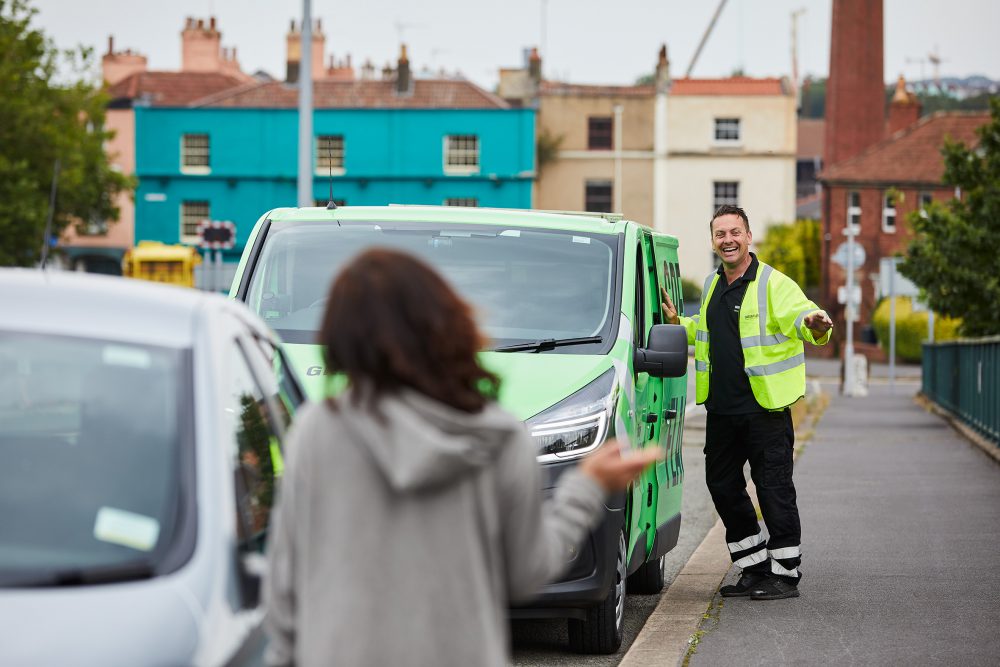
The electric vehicle market is growing. Quickly. And with government plans to phase out new petrol and diesel cars by 2030, the charge of the EV is showing no signs of slowing down.
EVs are exciting, but from a breakdown recovery perspective (one of our favourite perspectives), they are one of the biggest challenges in our industry right now.
Luckily, we like a challenge. That’s why we’re proud to announce that at the end of 2022, more of our technicians became Institute of the Motor Industry Level 3 and 4 qualified to work on EVs.
Nobody expects (or wants) their vehicle to break down. It’s stressful, it takes up time, it can cost you money if your vehicle needs repairs. Not a great list…
Unfortunately, it happens quite often. Here at Green Flag, we helped with over 500,000 jobs in 2021 alone.
Even though no driver wants to be in that situation, there’s a good chance you’ll have to call on a breakdown cover provider at some point in your life. So, if you don’t have cover already, now may be the time.
That’s why we’ve put all the important info you need about breakdown cover in one place.
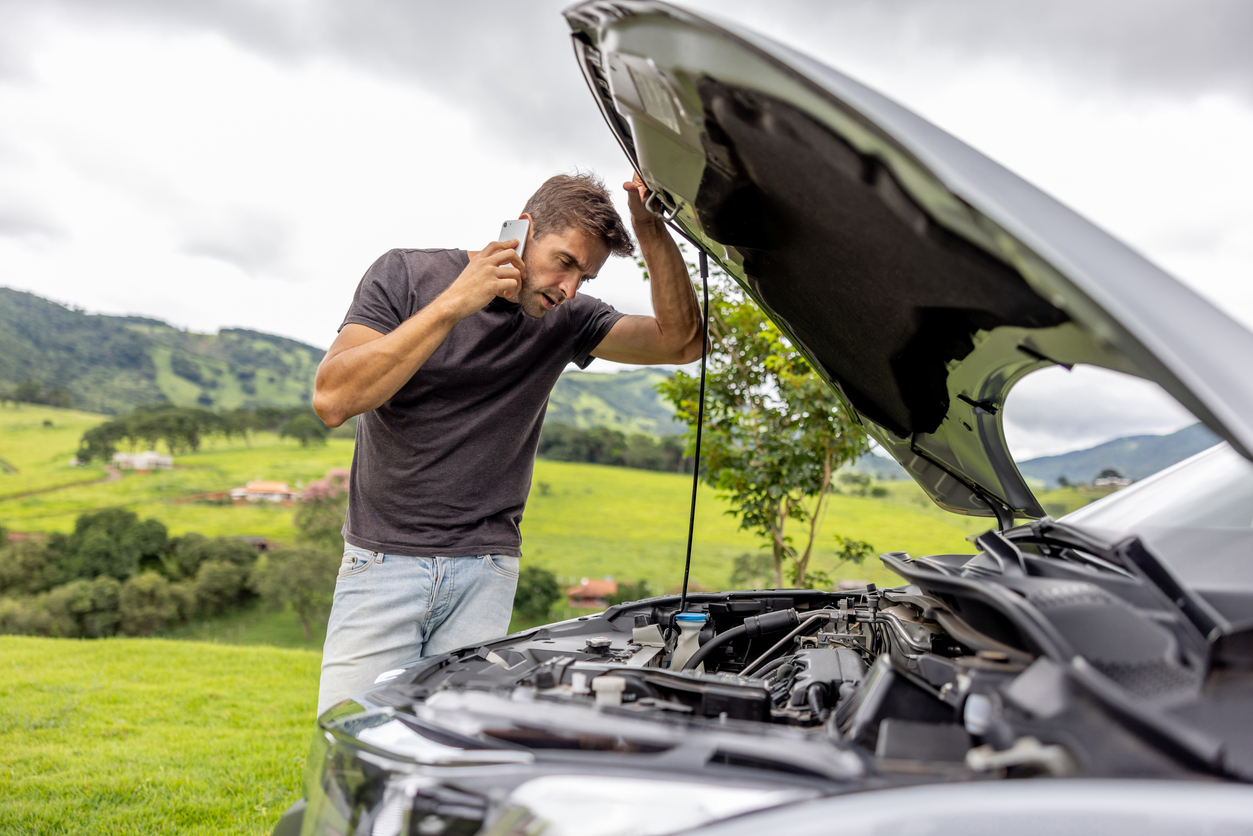
Breaking down usually happens when you least expect it (Picture iStock/Andresr)
You might think you have a relatively new, reliable car and don’t need breakdown cover. You probably won’t be surprised when I reveal we attend thousands of calls every year from drivers who have broken down in relatively new, apparently reliable cars.
Here’s a classic example. It’s been a cold night, you go to start your car in the morning and when you turn the key you just get a click and nothing else. Flat battery.
The debate about smart motorways is currently raging, so I wanted to clarify Green Flag’s policy on them, and provide the latest information on what happens if you do break down on one.
A quick
explanation of smart motorways
Smart motorways are split into three categories:
Dynamic hard shouldermotorways have a hard
shoulder on the left-hand side; however, it can be opened for traffic to ease
congestion.
Controlled motorways will have variable speed limits
shown on screens above the lanes themselves.
All lane running motorways don’t have a hard
shoulder, as every lane is used for traffic. You’ll find yellow-painted
‘emergency refuge areas’ every 600m to 1.5 miles. Any driver can use these
areas if there is an emergency or they break down.
If you ever see a red X on the screens above the
lane, that means the lane is closed. There may be a breakdown or people working
on the roadside. Do not drive on this lane until told otherwise (you’ll usually
see the red X replaced with a speed limit).
What to
do if you break down, but can still drive your vehicle
If you know there’s a problem, but you’re still able to
drive safely, try and leave the motorway and then contact us.
If this isn’t possible, then either use an emergency refuge
area or move to the left-hand side of the motorway.
Use an emergency refuge area:
If you’re unable to leave the motorway, aim for one of the emergency areas. As these areas can be up to 1.5 miles apart from each other, it’s worth noting when you last passed one so you can work out how close your next area is.
When you’re in an emergency area, make sure your hazard lights are on (as well as your sidelights if visibility is poor). Also, leave room behind and in front of your vehicle to allow emergency vehicle access.
Every emergency area has a phone that you can use to contact the local highways agency or the police – you’ll be automatically directed to them.
You can also call them from your mobile:
If you’re driving in England, call National Highways on 0300 123 5000.
If you’re driving in Scotland, call Traffic Scotland on 0800 028 1414.
If you’re driving in Wales, call Traffic Wales on 0300 123 1213.
If you’re driving in Northern Ireland, it’s recommended you call the police on 999.
If you’re safely in an emergency area, call the local highways agency before you get in touch with a breakdown cover provider. If you can’t safely leave your vehicle, or if you can’t get to an emergency area, call 999 immediately.
Move to the left-hand side of the motorway:
If an emergency area is not available, but you can still drive, the next best thing is to move to the left-hand side of the motorway. Use a hard shoulder if it’s available, or get your vehicle as close to the left-hand verge, boundary or a slip-road as possible.
If it’s safe to, have everyone leave using the left-hand doors, and if there’s a safety barrier, get behind it. Move away from the vehicle and stay at a safe distance from the motorway.
As your vehicle is not in an emergency area, call 999 as soon as you can. Make sure you call 999 before contacting your breakdown cover provider.
What to
do if you break down on an active lane
What happens here depends on what lane you are in.
If you’re on the left-hand lane (lane one):
If you break down on the left-hand lane (also known as ‘lane one’), we will be able to come to your rescue. However, there are some steps you need to take to stay safe.
Where possible leave the vehicle by the left doors and follow the instructions above.
If this is not possible, and you can’t safely exit the vehicle, then do the following.
First, make sure your seatbelt is left on and that you’ve put on your hazard lights. Second, call the police on 999 immediately. They’ll work with the local highways agency to close the lane (using the red X mentioned before) to help keep you safe.
We will come to your rescue, with the help of a fend-off
vehicle. This vehicle will sit further back on the lane to help shield you from
other vehicles. This fend-off vehicle will come at no extra charge to you.
We will never attempt fix a problem on the lane. We will tow
your vehicle off the motorway to somewhere safe. This minimises the amount of
disruption to other traffic and enables our technician to inspect your vehicle
safely.
If you’re on lanes two, three or four:
Breakdowns on these lanes need to be dealt with by the police or the local highways agency, as all lanes will most likely have to be closed.
If you’re unable to move to any of the areas previously mentioned, remain in your vehicle with your seatbelt and hazard lights on, then call the police immediately on 999. If you’re unable to call, stay calm. Smart motorways have control centres that use cameras to monitor the motorways. They will see the problem and will work to get you help as soon as possible. However, always call the police immediately if you are able to.
The
future of smart motorways
The smart motorway debate is an ongoing one.
At Green Flag, our priority is – and always will be –
customer safety. That’s why we’re an active member of SURVIVE (Safer Use of
Verges In Vehicular Emergencies). This is an industry body made up mainly of
government agencies and breakdown companies.
I personally sit on this, and we regularly discuss all areas
of the breakdown process from the industry’s perspective.
We’re currently debating how well Highways England, which
manages the motorway network on behalf of the Government, can support us in trying
to increase driver awareness about smart motorways.
In the meantime, I’d like to reassure all drivers that we’re
doing all we can to help ensure smart motorways are as safe as possible for everyone.
Cars have got better but roads have got worse in the last 25 years (Picture iStock/oversnap)
Do you remember what you were doing 25 years ago? What car you were driving, how much you spent on fuel and how congested the roads were?
Even if you don’t, you may recall signing up for cover from a
new breakdown company. It was called Green Flag and caused a splash by sponsoring
the England football team.
Twenty-five years later and Green Flag is still offering the same great service. Motoring, however, has changed significantly. It might not be quite beyond all recognition but things are certainly very different.
The MOT test changes this weekend but you can be forgiven if you didn’t know. New research conducted by Green Flag reveals that six out of 10 drivers (58 per cent) haven’t realised the MOT changes are happening.
More worryingly perhaps, nine out of 10 drivers (89 per cent) are unaware that driving a car with an invalid MOT might result in a £2500 fine. And a quarter (25 per cent) don’t realise that driving a faulty vehicle results in a penalty. Read on to find out more about the changes and how drivers might be able to save themselves money.
This March we saw a significant increase in the number of customers ringing us with their engine warning light on. These faults were up by more than a third (39.3 per cent) compared with February.
Warning lights can be worrying and frustrating in equal measure. They’re a worry because they indicate trouble. And when things go wrong with cars, it usually costs money. They’re frustrating because while the lights reveal a fault, they don’t tell you exactly what the problem is. Here’s what you need to know.
Sometimes technicians need to go to extreme lengths to find a fault in a car (Picture iStock/Boschettophotopgraphy
The older cars get the more likely they are to develop faults. And the worst of those is the intermittent fault; a noise or problem that’s there one minute, gone the next. The temptation for many of us is simply to tell the mechanic there’s an occasional rattling noise at the front and let them get on with it.
That’s fine but you wouldn’t go to the doctor, say you’ve got a pain in your leg and expect them to instantly diagnose the correct malady. And unlike most doctors, mechanics charge by the hour, so leaving them to find out what’s wrong will cost you.
But even the least mechanical people can make the technician’s life easier. And by doing so, they may even save themselves some money. Here’s how you should go about reporting an intermittent fault with your car to a garage.
Driving through mud isn’t rocket science. As you’ll see from my advice on how to cope with mud when you’re in a car, much of it is common sense. And that’s how I came to spend a day sitting at the wheel of an Isuzu D-Max pick-up truck, waiting to rescue competitors at the inaugural Green Flag Mud & Motors.
The event took place at the dauntingly named Devil’s Pit near Luton in Bedfordshire. We had Love Island finalist Chris Hughes plus six competitors. The idea was our six entrants had to do a lap of the four-wheel drive course. During that lap they had to make various choices based around common sense that would ensure they didn’t get stuck. They would score points on the way according to the decisions they made and the winner would get £1000. Here are four things I learned from the day.
One of the problems contestants for Mud & Motors are going to have is – as the event’s name suggests ‑ driving through mud. Manoeuvring any vehicle other than a tank over a slippery surface is easier said than done.
As a regional operations manager, I have some experience of driving in mud. And I’ll be working with the contestants on Mud & Motors to help them out. Here are my tips for driving in mud.
Rather than just a field with greasy grass, when I say mud I’m thinking more along the lines of muddy tracks here. It’ll have been driven on before, possibly by heavy vehicles such as tractors. Their weight and the tread of their tyres will have broken down the composition of the soil and turned it into mud. There will be puddles, ruts and thick, gloopy mud. Lots of it. Here’s how you get through it.
There are certain car faults you associate with cold weather and brake trouble probably isn’t one of them. But in the recent spell of extreme cold weather Green Flag saw a dramatic increase in call outs to do with braking systems.
The number of cars experiencing calliper problems increased by 52 per cent. And drivers having trouble with handbrake cables was up by 77 per cent. Read on to find out how brake faults happen and what you can do to rectify them.
As the Beast from the East bites and many of us wake up to almost unprecedented winter weather, I thought it a good idea to put together a snow set. And along with the equipment drivers should carry in their cars, I’ve also given some advice if they get stuck.
Of course, the best thing to do is to get the fire on, relax and watch the TV until the thaw sets in. But as appealing as that sounds, it isn’t always an option. If you must drive, here are some tips.
You probably don’t imagine cold weather and car suspension failures go hand in hand, but they do. During December, Green Flag witnessed nearly six times as many call outs for front suspension problems as in November. The number from December 2017 was up by nearly a quarter (24 per cent) compared to the same time the year before.
For our customers, this represents a significant problem. There isn’t just the cost of having expensive suspension parts replaced. It’s the inconvenience of the problem occurring in the first place. That’s because broken suspension isn’t usually a roadside fix: cars must be recovered to garages to be mended. Read on to find out more about this phenomenon.
Do you regularly check your car’s tyre pressures? Maybe you seek out a shady spot in a car park when the temperature is soaring? Or perhaps you have a dedicated key hook or drawer in the kitchen for the car keys?
If any of these rings true, then it’s likely you have a healthy helping of common sense. The good news is drivers who have common sense are more likely to find love and enjoy successful relationships.
According to new research conducted for Green Flag – which is well known for its common-sense prices and outstanding breakdown service – 79 per cent of people value common sense more than having a high IQ.
Cold weather isn’t just tough on drivers, it can play havoc with cars too. The heavy hail and snow showers that are hitting parts of the UK in mid-January 2018 are already causing chaos. Green Flag is warning that an astonishing 12 breakdowns every minute will take place this week.
Head of news for Green Flag Simon Henrick said: “After a variable but relatively mild winter period over Christmas, the changing weather conditions may take some drivers by surprise this week.
“By thoroughly checking their cars before leaving home, approaching the roads with caution and keeping plenty of distance between themselves and the vehicle in front, drivers will decrease the risk of encountering a problem while on the roads.” Read on to see how you can stay safe in the snow.
If a car starts, then refuses to start again almost immediately afterwards, it could be flooded with fuel
How do you start your car in the morning? Many of us have the same routine. And for some drivers, that could be the cause of a potentially inconvenient breakdown.
I love cars but my job as vehicle and customer data insight manager is all about figures and statistics. It involves analysing numbers and seeing how people – our customers ‑ use their vehicles on a daily basis. The results can be fascinating. Read on to see how the way you start your motor could leave you stranded at the roadside.
Going off to college can be a great adventure. Our tips will help ensure your car doesn’t spoil it
I’m sure there are some exceptions to every rule, but I’ve never yet met a student who’s rolling in money. And running a car that keeps on conking out can be like having a hole in your pocket. The key with cars is prevention rather than cure. Keeping on top of regular maintenance will prevent all manner of mechanical mishaps.
But more than that, a regular maintenance routine will actually help save you money. Tyres that are properly inflated don’t wear out as quickly and mean your motor won’t use as much fuel. And having the oil and filters changed when the maker suggests will guarantee your car performs as economically as possible. Read on to see my top car care tips.
If that’s a speeding ticket he’s writing, it could blow the holiday budget
More than four out of five British drivers are oblivious to tough new fines for speeding abroad. Just weeks after UK speeding fines changed in April 2017, the EU increased the penalty for breaking the limit on the Continent. That means drivers could be fined up to £640. Other motoring offences, such as not wearing a seatbelt and using a mobile phone at the wheel, are covered by the law change too.
When UK drivers were asked by Green Flag about their driving habits , the largest proportion (45 per cent) said they broke the speed limit abroad by mistake. And more than a third (38 per cent) claimed they find themselves speeding abroad because they don’t know the limits.
Imagine if your car could warn you of a pothole like this. You could then avoid it
Think about how useful a pothole warning system in your car might be. We’ve all felt that sickening thump on hitting a pothole. The first thought is frequently whether the wheel is still attached to the car, let alone how damaged. And with cold weather giving way to warmer temperatures, now is the time potholes begin to appear on winter-ravaged roads. But a new virtual map could make hitting potholes a thing of the past.